The Problem With High-Volume Content Strategies
I recently had a conversation that stuck with me.
My husband mentioned that one of his clients had just come off a discovery call with an “AI SEO agency.” The pitch was impressive on the surface. They had a team of experts using AI to generate and refine content at scale.
Dozens of articles per month.
Fast turnaround.
Constant output.
The kind of offer that makes you feel like you’re finally about to “catch up.”
And for a moment, I understood the appeal.
Because when your marketing isn’t working, the instinct is to do more.
More posts.
More pages.
More activity.
But here’s the problem.
More content doesn’t fix what’s already broken.
When More Becomes Noise
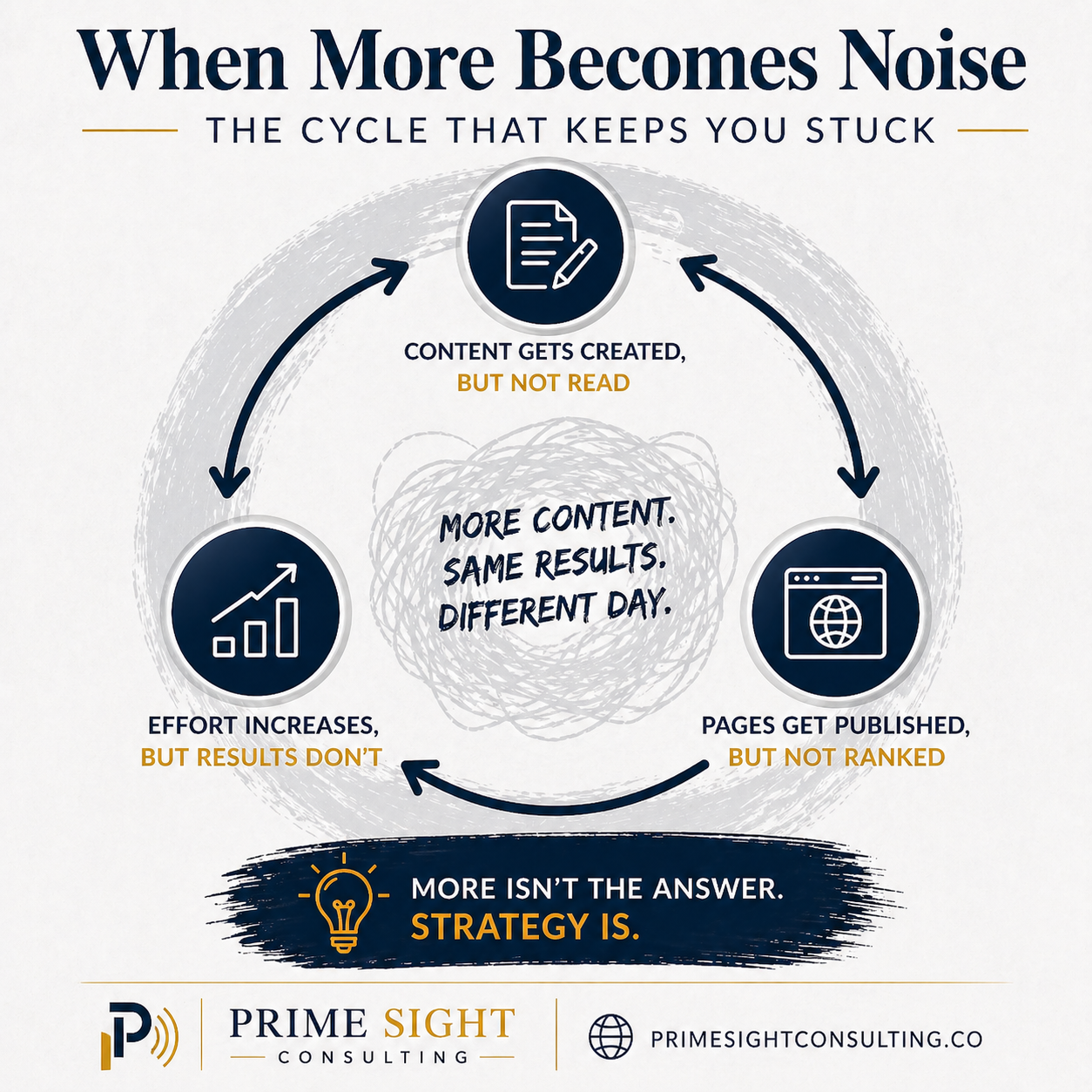
High-volume content strategies assume that visibility is a numbers game.
If you publish enough, something will stick.
But in reality, what usually happens is this:
Content gets created, but not read
Pages get published, but not ranked
Effort increases, but results don’t
Not because content doesn’t work.
But because the foundation isn’t clear.
Before You Create More, Pause
Before adding another blog post, another landing page, or another campaign, it’s worth asking a simple question:
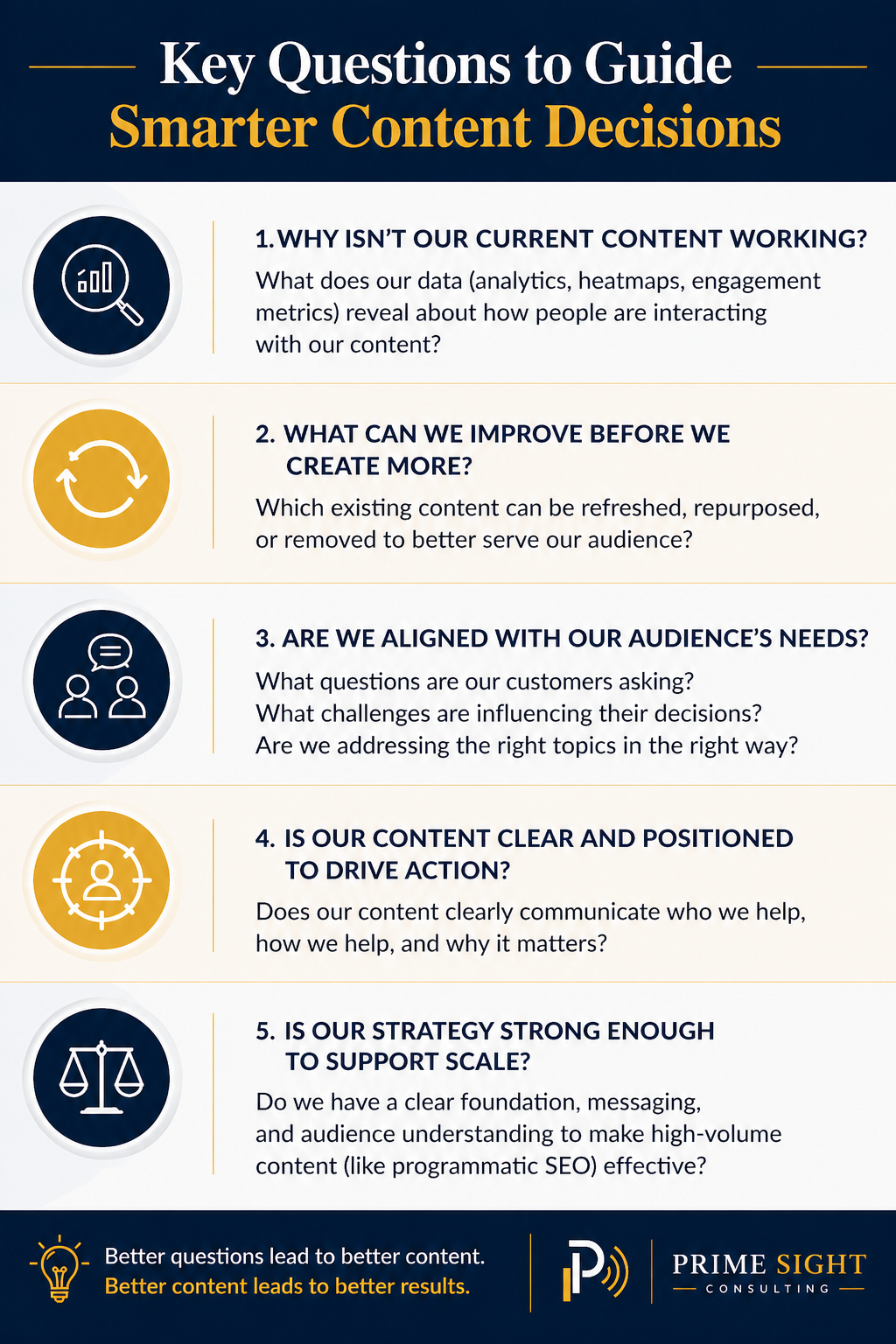
Why isn’t your current content working?
That answer is rarely found in guesswork.
It’s found in your data.
Look at how people are interacting with your website.
Use tools like heatmaps to understand where attention drops off.
Review your analytics to see what’s actually being read, watched, or downloaded and what’s being ignored.
There’s usually a story there.
And most of the time, that story isn’t “you need more content.”
Start With What You Already Have
In many cases, the opportunity isn’t to create something new.
It’s to improve what already exists.
Some content just needs to be refreshed.
Some needs to be repositioned.
Some needs to be removed entirely.
But all of it needs to be evaluated through one lens:
Is this helping the right audience understand why they should choose us?
If the answer is no, adding more content only compounds the problem.
The Disconnect No One Talks About
One of the biggest gaps I see is a disconnect between what businesses are saying and what their customers actually care about.
That disconnect shows up in subtle ways:
Content that answers the wrong questions
Messaging that feels generic
Topics that don’t reflect real buying decisions
The only way to fix that isn’t through tools. It’s through conversations.
Talk to your customers.
Talk to your sales team.
Understand what’s slowing decisions down.
Because when your content aligns with the real needs of customers, everything changes.

What Actually Drives Visibility
The goal isn’t volume.
It’s clarity.
Clarity in your message.
Clarity in your positioning.
Clarity in who you’re speaking to.
That’s what allows your content to:
Rank more effectively
Resonate more deeply
Convert more consistently
And that’s what builds authority over time.
Not 50 blog posts a month.
Where High-Volume Content Works (And Where It Doesn’t)
To be clear, volume isn’t the problem.
There are cases where high-volume content strategies make sense.
For example, B2B SaaS companies often use programmatic SEO to create comparison pages, integration pages, or location-based content at scale. In those cases, the structure is repeatable, the intent is clear, and the pages serve a specific purpose within the buyer’s journey.
But even then, volume only works when it’s built on a strong foundation.
The messaging is clear.
The positioning is defined.
The audience is well understood.
Without that, scaling content doesn’t create visibility. It creates noise.
So the question isn’t whether you should create more content.
It’s whether your current strategy is strong enough to support scale.
A Better Way to Approach Content
Instead of asking:
“How much content can we produce?”
Ask:
“What does our audience need to see, understand, and believe before they choose us?”
That question leads to better strategy.
And better strategy leads to better results.
If Your Content Feels Like It’s Not Working
It’s not always obvious what needs to change.
Sometimes you’re too close to it.
Sometimes everything looks “fine” on the surface.
But if the results aren’t there, something is off.
Start With Clarity
Before investing in more content, take the time to understand what’s not working and why.
The Prime Sight Clarity Intensive is a focused, two-week engagement designed to uncover gaps in your messaging, positioning, and visibility so you can move forward with a clear, strategic direction.
Schedule your Prime Sight Clarity Intensive to dive into the content strategy your brand truly needs.